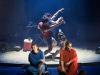
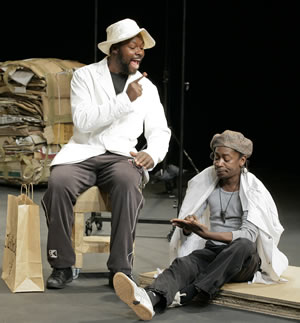
 Pitcho Womba Konga and Habib Dembélé. Photo - Catalin Anastase
{jumi[slides/slide.php][sizwe1107.php]}
Without the usual warnings of dimmed house-lights or music, a man enters the stage reading a newspaper. He exclaims in exasperation about the news it brings, putting politics up-front and setting the context for the piece to come.
Sizwe Banzi is Dead started out life as an apartheid-era South African township play by Athol Fugard, John Kani and Winston Ntshona. It tells two intersecting stories - one about a man who gets fed up working for white men at a Ford factory and becomes a photographer, and the other about a man who steals the identity of a corpse before sitting for a portrait by this photographer.
On face value, this story seems straight-forward, but the placement in the politically charged context of apartheid provides many subtexts and resonances. Legendary director Peter Brook’s assured touch embraces the peaks and troughs of the play’s delicate balance between comedy and drama - what a treat to finally see one of his works! The set is stripped-back and minimally symbolic of the play’s slum genesis, populated only with some frames on wheels, a stool on wheels and some piles of broken-down cardboard boxes.
This version has been translated into French, with English surtitles, but I found myself being so engrossed in the performances that I often forgot to read them. Both actors in this piece are excellent, and they command attention with their comic, expressive and physical style. Habib Dembélé (a political activist and writer from Mali) is particularly amazing, as his character Styles kicks off the play with a lengthy and energetic monologue. During the monologue, he performs countless impersonations as he tells the story of his career transition.
There is an irreverent joy in the storytelling here, especially when Styles gives a vignette of his experience working in the South African Ford factory. His impression of the big boss from the US is hilarious and wonderful. After Styles becomes a photographer and shoots a disastrous family portrait, a new customer (played by Belgian hip-hop musician Pitcho Womba Konga) comes in for his portrait. We then see the back story of the second man: a tale involving identity theft and the logistics of travel in the apartheid era.
This is a beautiful piece, and one that shows glimmers of hope and humour in an otherwise bleak existence. The intersecting stories act as metonyms for the state of life for black South Africans in apartheid - a state in which “we own nothing except ourselves.”
Sydney Opera House presents a CICT/Theatre des Bouffes du Nord production
Sizwe Banzi is Dead
Performed in French with English surtitles
Venue: Playhouse | Sydney Opera House
Dates: 27 November - 16 December
Duration: 1 hour and 15 minutes
Tickets: Adults: $68, Concession: $58
Bookings: www.sydneyoperahouse.com