



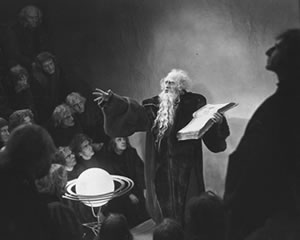
 German expressionist filmmaker F W Murnau's Faust (1926) is one of the classics of silent cinema and considered by many to be his masterpiece. Whilst 'silent' movies were never really silent – they were always accompanied by music and/or sound effects – they are rarely seen today with a musical accompaniment. Some years ago the Melbourne group Blue Grassy Knoll were known for accompanying Buster Keaton movies with their live, and lively, scores, but there hasn't been any widespread tradition of writing scores to accompany silent movies. Composer and musician Phillip Johnston is working to change this.
 Johnston, originally from New York but now resident in Sydney, loves music and silent movies and considers that a live score can help to make these classic films more accessible to contemporary audiences.
Johnston is a saxophonist, composer and arranger of both jazz and new music and has composed extensively for film, both silent and contemporary, theatre and dance as well as performing with a number of groups both here and overseas.
Johnston's score for Faust was commissioned by the Film Society of Lincoln Centre in New York and premiered at the New York Film Festival in 2003. Rather than try to replicate a score from the 1920s, Johnston chooses to draw on his musical knowledge and experience to create a score that at times complements and at other time counterpoints the action on the screen, and most notably he has added voice to the musical mix. Thanks to the Melbourne International Festival of the Arts and the Australian Centre for the Moving Image, Melbourne audiences – music lovers and film lovers –
have been given a chance to experience this magical marriage of image
and music.
Murnau draws on earlier versions of the Faust legend as well as Goethe's
classic text. His film begins with a wager between an angel and the devil, between good and evil. Faust (Gosta Ekman) is to be tested and the devil is certain that he will be
able to win his soul forever. There are some stunning images that
stay in the imagination: the opening sequence with the Horsemen of
the Apocalypse riding through the sky; the image of the cloaked Satan (Emil Jannings) looming over and slowly enveloping the small township where Faust lives; and another stays with me as much for the music score as the image – that of the imprisoned Gretchen (Camilla Horn) maddened with grief having lost her child and her lover, Faust. Along with the drama and tragedy there are some delightful comic moments. When Faust first calls up the Prince of Darkness (Satan/Mephisto) the latter appears as a plump peasant who grins and doffs his cap to
Faust. Clearly scared of what he has set loose, Faust flees through the forest only to find the same cheerful 'peasant' appearing everywhere he turns. Finally he reaches his home to be greeted by the 'peasant' and so the seduction begins.
Johnston's score is written for cello (John Napier), accordion (Elizabeth Jones), saxophone, ukulele and piano (Phillip Johnston) and voice (Lauren Easton). The libretto is written by Hilary Bell. At times the music evokes the era of the silent movie with its use of accordion and ukulele, at others it is jazzy and contemporary. Equally the lyrics vary between the dignity of church singing; the up-tempo as faced with the threat of plague some villagers decide to throw all caution to the wind and live it up; to a sly commentary on love, love is from hell! A breathy use of the accordion helps heighten the tension as Faust draws near to Gretchen's bedroom window and a manic, lively tune contrasts movingly with the images of the maddened Gretchen languishing in her cell. The beautiful voice of Lauren Easton, sometimes singing lyrics at others vocalising, adds an especially effective and moving dimension to the whole performance.
The end result, the combination of Murnau's dramatic, sometimes comic, tragic exposition of the battle between good and evil, with Johnston's score enhances the beautiful imagery and the emotional journey of the film, so that one feels truly moved and emotionally drained by the end of the performance. Let's hope that there will be other opportunities to see such films enhanced and accompanied by such rich and challenging scores.
Australian Centre for the Moving Image and Melbourne International Arts Festival presents
FW Murnau’s Faust
with original musical score by Phillip Johnston
Venue: Australian Centre for the Moving Image, ACMI Cinemas
When: Sat 11 Oct & Sun 12 Oct at 7pm; Sun 12 Oct at 1pm
Duration: 1 hour 57min no interval
Prices: Full $25 / Conc $20
Bookings: ACMI Box Office (03) 8663 2583 / www.acmi.net.au / www.melbournefestival.com.au