




 While the first concert of the series Seven Words unlocked a fountain of novel experience for musicians and audience, the second concert left mixed sentiments. The program included The Seven Last Words of Our Saviour on the Cross by Joseph Haydn, interspersed with world premieres of new Australian music.
Haydn’s work was performed in its arrangement for string quartet by the members of the Australian National Academy of Music Orchestra. Seven groups of musicians played and gradually took their places at the front to play the final Presto (The Earthquake) as an orchestra. Unfortunately, their energetic gesture was reserved only for this Presto. The string quartet interpretations suffered badly from lack of strong ensemble work, confidence of attack, phrasing and in-depth reading of the ten-minute Adagios. Haydn’s musical language speaks through stylised eighteenth-century rhetorical structures and figurations which should have been explained to and workshopped with the young musicians. With the exception of the ensemble, which played the fifth Adagio, it was obvious that the rest of the performers had little experience in both ensemble playing and in spending enough time together to prepare these particular pieces. It is dangerous to put young musicians on the spot during such important professional forums. The quartets’ performances verged on boring and were not helped by the unusual extended length of the concert, one hour and forty five minutes.
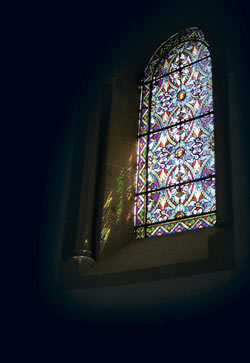
The wooden hexagon set was erected vertically for this concert; this time only five arms opened like a mystical pentagram. As if to spatially juxtapose the old from the new music, the hexagon’s transparent surface divided the performance space between this for the string quartets, a stage erected behind the hexagon, and that for the new music, in front of the stage. Theatrical fog made the lighting noticeable and added to the numinous atmosphere.
More than 600 people had come to St Patrick’s Cathedral to hear seven world premieres of new Australian music. Brett Dean’s Etude for Two Horns, Anthony Pateras’ trio for woodwind Thirst, and James Ledger’s Descent for contrabassoon and contrabass clarinet echoed from different corners of the cathedral, at times sounding like organ pipes. What is more, this sacred space had never housed rock avant-garde music. Ingwe (Night) by Georges Lentz, played by Zane Banks on the electric guitar, had to be violent and unbearable to achieve a sudden chime effect and to expose silence at the end.
The first two of the new works were the highlights of the evening. William Barton (didjeridu) executed his Response with immense virtuosity. Standing in the centre of the stage and lit from above, he conquered the audience with his strong presence immediately. William enveloped the cathedral with a soundscape, which evoked deep love for the vast pulsating Australian land. Obvious historical and political references to forgiveness, the theme of the first word, were made. Andrew Ford’s In Paradiso induced a natural high in the listeners through layered sustained tones played by three flutists, standing in a triangle outside the performance space. The experience was thrilling and prolonged. Is it possible to experience so much rapture that you desire its end?
Melbourne International Arts Festival, Australian National Academy of Music and Victorian Opera present
Joseph Haydn: Seven Last Words of Jesus Christ on the Cross
Venue: St Patrick's Cathedral
Date/Time: 9:00pm Wed 14 October 2009
Visit: www.melbournefestival.com.au
Read our review of Seven Words: Sofia Gubaidulina»
Read our review of Seven Words: James MacMillan»
There is a reason The Sapphires has become one of Australia's most beloved musicals.
3 June 2026
Canberra

2 June 2026
Sydney

30 May 2026
Sydney
Latest Reviews
Seven Words: Joseph Haydn
- Details
More from this author
Messiah (Original Dublin Version, 1742) | Pinchgut Opera
Vivacious and virtuosic, Pinchgut Opera’s intimate rendition is rooted deeply in research...