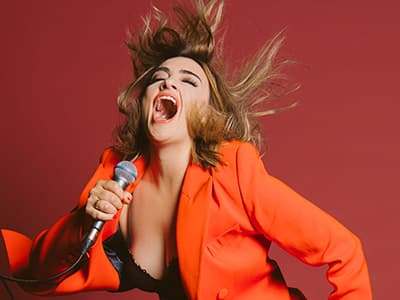
As I take my last breath, I remember my first.
Both meet somewhere in the centre of my chest
and they convulse.
My irises bulge wide as I make eye contact with the two people watching me.
Do I know them or are they strangers?
Both.
Afterwards they give me feedback.
All I hear is “what the fuck was that?”
Their shock and awe are neither complimentary nor derogatory.
And in my bones, I feel the remembrance of once being a performer.
Or perhaps it’s simply the growing willingness – with age – to be fully alive.
The Festival of Death and Dying is held with immense care by Dr Peter Banki, a philosopher and cultural provocateur dedicated to dissolving taboo with tenderness, and others including Victoria Spence, an icon of Australian performance art and a grounded death doula whose presence shapes the festival’s integrity and safety.
This is an event curated by people who understand the body, grief, ritual, and the edges of what performance can reveal.
Naarm based Taka Takigushi’s A Body of 48 begins with a story passed down from his grandmother about her first husband – not his grandfather.
It is 1945.
It is wartime.
In the night he grows weak; she supports him on a walk to the bathroom in the dark. They fall to the ground and cannot get up. He survives the night but dies the following morning.
She wrote the story down sixty years later.
Taka breathes life back into it.
He introduces a quote that lands heavily in the room:
“people die twice –
when they leave their body
and when their name is spoken for the last time.”
What follows is a haunting film-performance: sheets moving, bodies shifting beneath cloth, lips narrating the story like the mouth from The Rocky Horror Picture Show – but its raw and blotchy – grimy pool tiles, frangipani, a bee, a masked or mummy-like figure, a ball of string, and Taka’s body layered and re-layered through shadows and piano sound.
The imagery forms its own internal language.
What does the bee signify?
The frangipani?
The string?
Memory? Soul? Echoes?
Or simply the residue of a life trying to stay remembered?
After the film, Peter Banki invited us to anchor into our bodies and remember people touched by war – personally, ancestrally, or imaginally – and to call their names aloud. We stood in pairs.
I chose not to invite touch. My partner did, and I enjoyed the opportunity to offer steady, quiet care.
I don’t have direct reference points for war, but grief feels built into us. I tried to open myself to whatever might be held in my own DNA.
I saw a red headed woman with broken and decaying teeth.
Tony Yap’s Danse Macabre workshop followed – a slow, visceral descent through spine, limbs, weight, breath. Moving with the tiniest impulses. Letting the body soften and collapse, and rise into power shapes.
The falling came easily to me; the power less so.
Tony asked who among us were dancers. I kept my hand down – unclear of the question. But in Tony’s space, that distinction dissolved anyway.
Trained dancers, non-dancers, movement-regulars … all felt levelled, unified by the fragility of the task.
The final exercise – to perform our first breath, and our last - to open our eyes and allow ourselves to be witnessed – felt like exposure from the inside out.
I wanted to flee. Instead, I stayed. Tony’s facilitation was gentle, quiet, and grounding, and he led us through a kind of embodied contemplation of mortality that was both subtle and profound.
The day took place at Critical Path on the exquisite shores of Rushcutters Bay – a research centre dedicated to choreographic exploration and movement inquiry.
This mattered deeply.
So many mind–body–spirit gatherings take place in cavernous halls or fluorescent rooms that disconnect from intention.
But here, in a space built for artists to inquire with their bodies, everything felt held, reflective, and safe.
Between workshops, delicious and nourishing food was offered – simple, grounding, and created with care. There was genuine space to speak with others, or to sit alone without pressure. Everything felt allowed.
The closing ceremony performance by Katya Petetskaya was visually arresting: a surreal, pantyhose-clad body layered with a tiara, a tutu, and mirrors that refracted and distorted her form in the fading light.
It was beautiful and strange, and an unexpected choice for the final moment of the festival.
While the imagery was compelling, the intention behind the work felt obscured – less like deliberate ambiguity and more like a piece still searching for its emotional centre. It didn’t feel hollow, just incomplete, as though its meaning hadn’t quite landed yet.
Still, ending with an enigma carried its own quiet boldness – a reminder that death, like art, often refuses to resolve neatly.
Like many a theatre loving Canberran I travelled up on the Murray’s bus, and could only attend the Sunday program. I heard that Saturday was extraordinary and felt genuinely disappointed to miss it.
By the end of the day, I felt sick to my stomach, almost immovable – not from any one piece, but from the cumulative emotional weight of everything we had witnessed.
The stories, the bodies, the rituals, the images, the vulnerability in the room … it all settled into me like a deep internal stirring that continued long after I left.
Next year I intend to be there for the full weekend.
The Festival of Death and Dying is not just a festival – it is a tender, artist-led act of remembering, and a deeply human invitation to witness ourselves, one another, and the stories that insist on being carried forward.
Event details
Festival of Death and Dying 2025
Director Peter Banki Ph.D
Venue: The Drill Hall | 1c New Beach Road, Darling Point NSW
Dates: 22 – 23 November 2025
Bookings: https://deathfest.sydney